

SpaceX's historic initial public offering (IPO) is more than a headline. It's a signal. The most compelling response is to own the full frontier, not just one single name.
SpaceX At A Glance (as of June 4, 2026)
- >80% global mass sent to orbit by SpaceX1
- >12M Starlink subscribers, 160+ countries2
- $1.25B monthly compute revenue (Anthropic deal)3
ARKX At A Glance (as of June 30, 2026)4
- 37 holdings in the fund
- 8.83% SpaceX weight in ARKX
- 80% Active Share vs. Nasdaq 100
- $1.8B AUM
The SpaceX IPO: You've Heard Of It—Here's Why It Matters For ARK Space & Defense Innovation ETF (ARKX)
On June 12, 2026, SpaceX listed on the Nasdaq under the ticker SPCX, completing the largest initial public offering in the history of capital markets and raising up to $75 billion at a ~$1.75 trillion valuation.5 For most investors, it was the first moment they could buy SpaceX. ARK had been invested in the name for years.
ARK has invested in SpaceX through its private lifecycle via the ARK Venture Fund participating across funding rounds associated with its core aerospace business, Starlink, and xAI. ARKX received an allocation in SpaceX's IPO that placed SpaceX at approximately 9.10% of the fund at the end of the first full week of trading.6
"The questions now flooding investor inboxes about SpaceX are ones ARK has been preparing to answer for years. We owned it before anyone else could."
The Pace Of Convergence
The pace of convergence grounds our thesis in reality: SpaceX sits at the center of reusable rocketry, satellite connectivity, artificial intelligence, and orbital computing, each technology reinforcing the others. Consider the evidence now in the public domain:
- Starlink has scaled to >12 million subscribers across 160+ countries, generating $11.4 billion in revenue in 2025—currently the only consistently profitable segment of the business, growing at ~50% year-over-year.7
- SpaceX accounts for more than 80% of the world's payload mass sent to orbit since 2023, and the company conducted 165 orbital launches in 2025, reducing the cost to orbit by roughly 95% since 2008, according to our research.8
- The orbital data center thesis is beginning to appear more plausible. With xAI now merged with SpaceX, the company's Colossus data center in Memphis houses over 220,000 Nvidia Graphics Processing Units (GPUs).9 ARK's research suggests that at sub-$100 per kilogram launch costs—the Starship target—orbital compute ultimately could be delivered at significantly lower cost than terrestrial alternatives, free from grid delays, planning restrictions, and power scarcity.10
In May 2026, Anthropic agreed to pay $1.25 billion per month through May 2029 for access to SpaceX's Colossus infrastructure—a contract potentially worth more than $40 billion across its full term, though Elon Musk has stated that the deal is short-term and can be terminated on a 90-day notice.11 In our view, that relationship materializes convergence: reusable rockets enabling AI infrastructure, which monetizes at a scale no purely terrestrial operator can match.
A word on post-IPO volatility. SpaceX's stock has experienced meaningful price discovery since listing, an entirely normal and consistent phenomenon that attends every major technology listing of that magnitude. Price discovery for an asset with SpaceX's long-horizon earnings profile takes time. Short-term movements do not alter the underlying business trajectory, however. ARK's investment philosophy is built on a multi-year horizon in terms of which the convergence thesis only strengthens.
Why Own Industry Innovators, Not Just The Brightest Star?
While SpaceX commands an extraordinary position, the space economy does not begin and end with a single company, however dominant. History shows that transformative technology shifts produce ecosystems. The internet era created Amazon, Google, and Netflix alongside many others. The smartphone era produced Apple and an entire supply chain of beneficiaries. Space should be no different.
That said, winner-take-most dynamics are real in aerospace. Launch is a business with massive fixed costs and steep learning curves, and we believe SpaceX's reusability advantage is durable. Which is precisely why active management matters: we can distinguish between companies that should capture lasting value and those that are riding cyclical momentum. That requires a proven methodology and persistent rigorous analysis and action. ARKX is a concentrated portfolio of approximately 30–40 names—not a passive index—and every position we hold has our conviction.
Within ARKX, SpaceX sits alongside a carefully selected group of companies benefiting from the same secular tailwinds:12
- Rocket Lab: one of the most compelling small-launch operators globally, opening a market for dedicated, rapid-deployment missions that SpaceX's scale cannot efficiently serve. As launch frequency accelerates, Rocket Lab's addressable market expands in parallel.
- AeroVironment: a pioneer in unmanned aerial systems (UAS) increasingly vital to modern defense, intelligence, and battlefield situational awareness. Its drone technology converges directly with the satellite and sensor networks that orbital infrastructure enables.
- Kratos Defense & Security Solutions: a leader in high-performance unmanned systems and space ground infrastructure, with significant exposure to the growing government and defense demand for autonomous systems.
- L3Harris Technologies: a global prime defense electronics and communications company, deeply embedded in the satellite communication networks and integrated sensor ecosystems that underpin modern defense.
Such aggregate exposure matters as much as any individual name, in our view. In a technology cycle as early-stage as orbital AI infrastructure, exposure across the supply chain—from launch to satellite operations to defense applications—reduces single-name risk while preserving full participation in the theme.
Space Or Defense? The Answer Is Both, And It's Secular
Defense has been a dominant performance driver in recent years, fueled by geopolitical realignment, NATO spending commitments, and the renewed urgency around military modernization. ARK expects that trend to continue, thanks to a set of structural forces: Europe's defense rebuild, the Indo-Pacific competition, and the increasing integration of autonomous systems into military doctrine—all robust generational shifts.
Indeed, 2026 could be the year in which space reasserts itself as the dominant growth theme within the ARK Space & Defense Innovation ETF (ARKX). SpaceX's IPO has drawn unprecedented investor attention to the sector, and space has become the foundational infrastructure layer for modern defense. In our view, GPS, signals intelligence, missile early warning, and battlefield communications all depend on orbital infrastructure. In other words, space is not adjacent to defense but its central nervous system.
The companies building satellite constellations are also building the command-and-control architectures for the next generation of warfare, and the companies building autonomous drones depend on orbital networks for navigation and coordination.
"Space and defense are not competing themes. They are co-dependent. ARKX is built on the belief that the most powerful long-term exposure to both is a single, actively managed fund positioned at their intersection."
The Case for ARKX: Potential Benefits of Owning the Frontier
We believe SpaceX is an extraordinary company, but ARKX was not built to revolve around a single name. Instead, the fund manifests the thesis that space and defense are converging into one of the most consequential technology cycles of our lifetime, that we are early this cycle, and that active management is the most appropriate way to navigate it.
The potential benefits of owning the full fund are straightforward. Owning SpaceX by itself means navigating extraordinary ambition alongside extraordinary complexity—a single point of execution risk, governance concentration, and sensitivity to one founder's decisions. By contrast, owning ARKX means exposure to SpaceX plus the companies enabling, supplying, and operationalizing the broader space and defense ecosystem, with the ongoing benefit of ARK's active research, daily portfolio management, and the discipline to rotate as the opportunity set evolves.
SpaceX's IPO is a gateway event that we believe will bring a new wave of investors into the space theme for the first time, and it will likely bring new scrutiny, new capital, and new momentum to the entire sector. The question is not whether to notice but how best to take advantage. We believe a concentrated, actively managed portfolio of frontier innovators offers the most compelling answer: broad participation, expert navigation, and conviction without overconcentration.
Important Information
Investors should carefully consider the investment objectives and risks as well as charges and expenses of an ARK ETF before investing. This and other information are contained in the ARK ETFs’ prospectuses, which may be obtained by visiting www.ark-funds.com. The prospectus should be read carefully before investing.
Investing in securities involves risk and there's no guarantee of principal.
Fund Risks: The principal risks of investing in ARKX: Equity Securities Risk. The value of the equity securities the Fund holds may fall due to general market and economic conditions. Foreign Securities Risk. Investments in the securities of foreign issuers involve risks beyond those associated with investments in U.S. securities. These risks are greater in emerging markets. Industrials Sector Risk. The industrials sector includes companies engaged in aerospace and defense, electrical engineering, machinery, and professional services. Companies in the industrials sector may be adversely affected by changes in government regulation, world events and economic conditions. In addition, companies in the industrials sector may be adversely affected by environmental damages, product liability claims and exchange rates. Information Technology Sector Risk. The information technology sector includes companies engaged in internet software and services, technology hardware and storage peripherals, electronic equipment instruments and components, and semiconductors and semiconductor equipment. Information technology companies face intense competition, have limited product lines, markets, financial resources or personnel, face rapid product obsolescence, are heavily dependent on intellectual property and the loss of patent, copyright and trademark protections may adversely affect the profitability of these companies.
Aerospace and Defense Company Risk. Companies in the aerospace and defense industry rely to a large extent on U.S. (and other) Government demand for their products and services and may be significantly affected by changes in government regulations and spending, as well as economic conditions, industry consolidation and other disasters. Disruptive Innovation Risk. Companies that ARK believes are capitalizing on disruptive innovation and developing technologies to displace older technologies or create new markets may not in fact do so. Companies that initially develop a novel technology may not be able to capitalize on the technology. Companies that develop disruptive technologies may face political or legal attacks from competitors, industry groups or local and national governments. These companies may also be exposed to risks applicable to sectors other than the disruptive innovation theme for which they are chosen, and the securities issued by these companies may underperform the securities of other companies that are primarily focused on a particular theme. Special Purpose Acquisition Companies (SPAC) Risk. A SPAC is a publicly traded company that raises investment capital for the purpose of acquiring or merging with an existing company. Investments in SPACs and similar entities are subject to a variety of risks beyond those associated with other equity securities. Because SPACs and similar entities do not have any operating history or ongoing business other than seeking acquisitions, the value of their securities is particularly dependent on the ability of the SPAC’s management to identify a merger target and complete an acquisition. For other risks regarding the fund please see the prospectus. There can be no assurance that the ETF will achieve its investment objective. The ETF’s portfolio is more volatile than broad market average.
Shares of ARKX are bought and sold at market price (not NAV) and are not individually redeemed from the ETF. ETF shares may only be redeemed directly with the ETF at NAV by Authorized Participants, in very large creation units. There can be no guarantee that an active trading market for ETF shares will develop or be maintained, or that their listing will continue or remain unchanged. Buying or selling ETF shares on an exchange may require the payment of brokerage commissions and frequent trading may incur brokerage costs that detract significantly from investment returns.
Securities in the ETF’s portfolio will not match those in any index. The active ETFs are benchmark agnostic and corresponding portfolios may have significant non-correlation to any index. Index returns are generally provided as an overall market indicator. You cannot invest directly in an index. Although reinvestment of dividend and interest payments is assumed, no expenses are netted against an index’s returns. An indication of interest in response to this advertisement will involve no obligation or commitment of any kind.
Portfolio holdings will change and should not be considered as investment advice or a recommendation to buy, sell or hold any particular security.
To view the top ten holdings for ARKX click here.
The information herein is general in nature and should not be considered financial, legal or tax advice. An investor should consult a financial professional, an attorney or tax professional regarding the investor’s specific situation. Certain information was obtained from sources that ARK believes to be reliable; however, ARK does not guarantee the accuracy or completeness of any information obtained from any third party.
ARK Investment Management LLC is the investment adviser to the ARK ETFs.
Foreside Fund Services, LLC, distributor.
SpaceX. 2026a. "Form S-1 Registration Statement." U.S. Securities and Exchange Commission. BryceTech. 2026. "2025 Year in Review."
SpaceX. 2026b. "Starlink."
SpaceX. 2026a. "Form S-1 Registration Statement." U.S. Securities and Exchange Commission.
ARK Invest. 2026a. "ARK Space & Defense Innovation ETF."
SpaceX. 2026a. "Form S-1 Registration Statement." U.S. Securities and Exchange Commission.
ARK Invest. 2026a. "ARK Space & Defense Innovation ETF."
SpaceX. 2026a. "Form S-1 Registration Statement." U.S. Securities and Exchange Commission.
Space.com. 2025. "SpaceX shatters its rocket launch record yet again."
SpaceX. 2026a. "Form S-1 Registration Statement." U.S. Securities and Exchange Commission.
ARK Invest. 2026b. SpaceX orbital-compute cost estimate. Forecasts are inherently limited and cannot be relied upon.
SpaceX. 2026a. "Form S-1 Registration Statement." U.S. Securities and Exchange Commission.
ARK Invest. 2026a. "ARK Space & Defence Innovation ETF."
ARK’s statements are not an endorsement of any company or a recommendation to buy, sell or hold any security. ARK and its clients as well as its related persons may (but do not necessarily) have financial interests in securities or issuers that are discussed. Certain of the statements contained may be statements of future expectations and other forward-looking statements that are based on ARK’s current views and assumptions and involve known and unknown risks and uncertainties that could cause actual results, performance, or events to differ materially from those expressed or implied in such statements.


ARK Trade Notifications
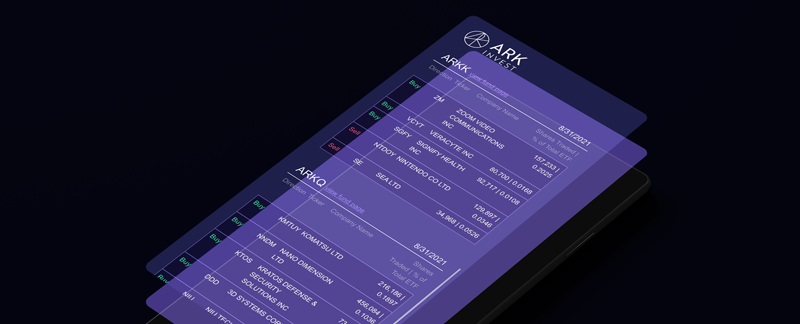
ARK offers fully transparent Exchange Traded Funds (“ETFs”) and provides investors with trade information for all actively managed ETFs.